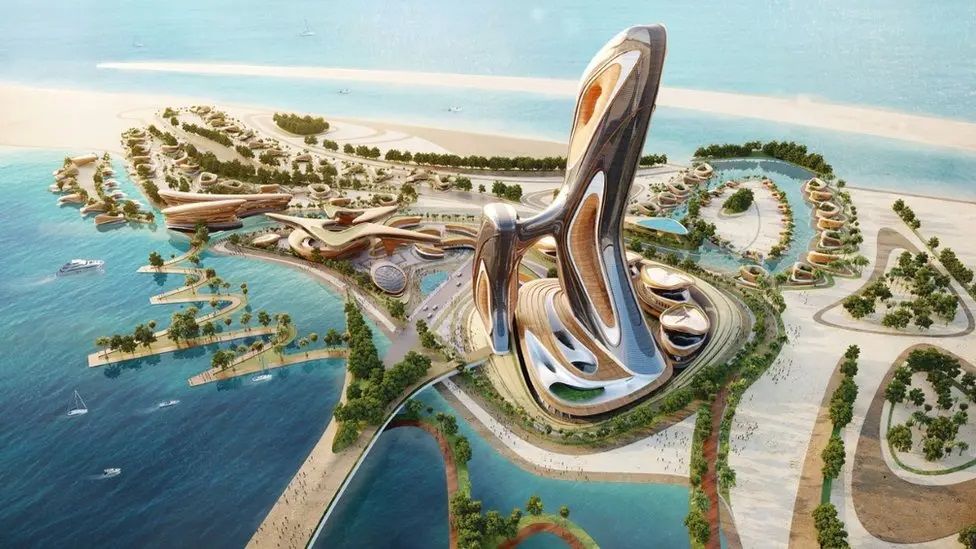
Akon, the musician and entrepreneur with dual Senegalese and American heritage, made waves worldwide with his ambitious plan to establish a modern, $6 billion smart city in Senegal, where his ancestors are from. Presented as a technologically advanced paradise driven completely by sustainable energy and featuring its own digital currency, “Akon City” aimed to revolutionize the area by merging technological advancements with economic prospects. Despite the initial excitement, years after the project was unveiled, it seems to have faced significant delays, with reports suggesting the city remains mostly uninhabited.
When Akon unveiled the concept in 2020, the idea was met with both excitement and skepticism. Drawing inspiration from movies like Black Panther, the artist imagined a cutting-edge metropolis complete with skyscrapers, luxury resorts, a tech hub, and sustainable infrastructure. The city was intended to run on Akoin, a cryptocurrency designed to empower African economies. At the time, Akon described the project as a way to provide jobs, stimulate growth, and offer a symbol of African progress.
The proposed location for Akon City was a 2,000-acre plot along the Atlantic coast, near the Senegalese village of Mbodiène. The government of Senegal reportedly donated the land, seeing the project as an opportunity to boost tourism, investment, and development. Akon claimed to have secured funding from private investors and envisioned the first phase of construction—consisting of roads, homes, and a police station—completed by 2023.
However, as time passed, little physical progress became evident on the site. Journalists and local residents visiting the area have described the land as virtually untouched, with only a small sign marking the future site of the city. Reports indicate that no major construction has taken place, and many of the ambitious promises remain unfulfilled.
For the people living near the proposed development, the absence of progress has raised doubts and frustration. Some had anticipated new job opportunities, infrastructure, and tourism-driven benefits. Instead, they continue to live in villages with limited access to basic services, while the dream of Akon City seems increasingly out of reach.
The absence of noticeable progress has led to speculation about whether the project was ever financially feasible or overly ambitious from the start. Significant urban initiatives necessitate considerable, continuous funding and coordination—especially in areas where infrastructure remains under development. Certain analysts have highlighted the difficulties of initiating such a sophisticated city in a place lacking the essential groundwork.
Akon, for his part, has maintained in interviews that the project is still alive, citing delays related to the COVID-19 pandemic and economic disruptions as key reasons for the slow pace. He has emphasized that building a city from scratch is a complex, multi-year undertaking that requires careful planning and resource allocation. Yet despite these reassurances, public trust in the project appears to have eroded as the promised progress remains unseen.
The broader idea behind Akon City—using blockchain technology, green energy, and futuristic design to empower African communities—resonated with many who hoped for transformative change on the continent. Africa is home to some of the world’s fastest-growing economies, and young populations hungry for innovation. Akon’s vision aligned with a larger narrative of homegrown solutions and modern African success stories.
However, the actual implementation of these ambitious undertakings has turned out to be an entirely separate challenge. Akon City is not the initial major project on the continent to experience obstacles. Many proposed smart cities throughout Africa, including Kenya’s Konza Technopolis and Nigeria’s Eko Atlantic, have faced similar postponements, financial hurdles, or scaled-down plans compared to their original assurances.
El desfase entre ideales visionarios y realidades prácticas enfatiza los retos de ejecutar megaproyectos en economías emergentes. Problemas tales como la propiedad de tierras, financiamiento, asociaciones con el gobierno y obstáculos regulatorios pueden complicar incluso los planes mejor intencionados. Además, la mera magnitud de construir una ciudad futurista desde cero plantea desafíos logísticos que son difíciles de superar sin un apoyo considerable y constante.
For many in Senegal, the story of Akon City is a cautionary tale about grand promises that fail to materialize. While the artist’s intention to give back to his homeland and contribute to Africa’s future development is widely acknowledged, the lack of tangible progress has left many disillusioned.
The situation has also sparked wider discussions about how progress should happen in Africa. Detractors contend that extensive, centralized initiatives frequently shift focus away from urgent, community-driven strategies that might directly affect individuals’ lives. Instead of prioritizing prominent, costly urban developments, some suggest directing resources toward education, healthcare, local enterprises, and current urban areas.
Akon’s high-profile involvement brought international attention to the idea of African-led innovation and the potential for economic growth on the continent. Regardless of whether Akon City ultimately comes to fruition, the discourse it sparked about Africa’s future, technology’s role, and the importance of infrastructure and investment remains significant.
As of now, the proposed site remains largely empty, and timelines for construction remain unclear. Supporters of the project still express hope that the dream can be revived, while skeptics point to it as another example of overpromising without the means to deliver.
The story of Akon City serves as a reflection of both the aspirations and the complexities of development in Africa. It underscores the importance of balancing visionary ideas with practical execution and ensuring that communities who stand to be affected by such projects are not left waiting indefinitely for change that may never come.
While the fate of Akon’s futuristic city remains uncertain, its legacy may lie less in its physical construction and more in the conversations it sparked about how African nations can harness innovation, technology, and entrepreneurship to shape their own futures—on their own terms.