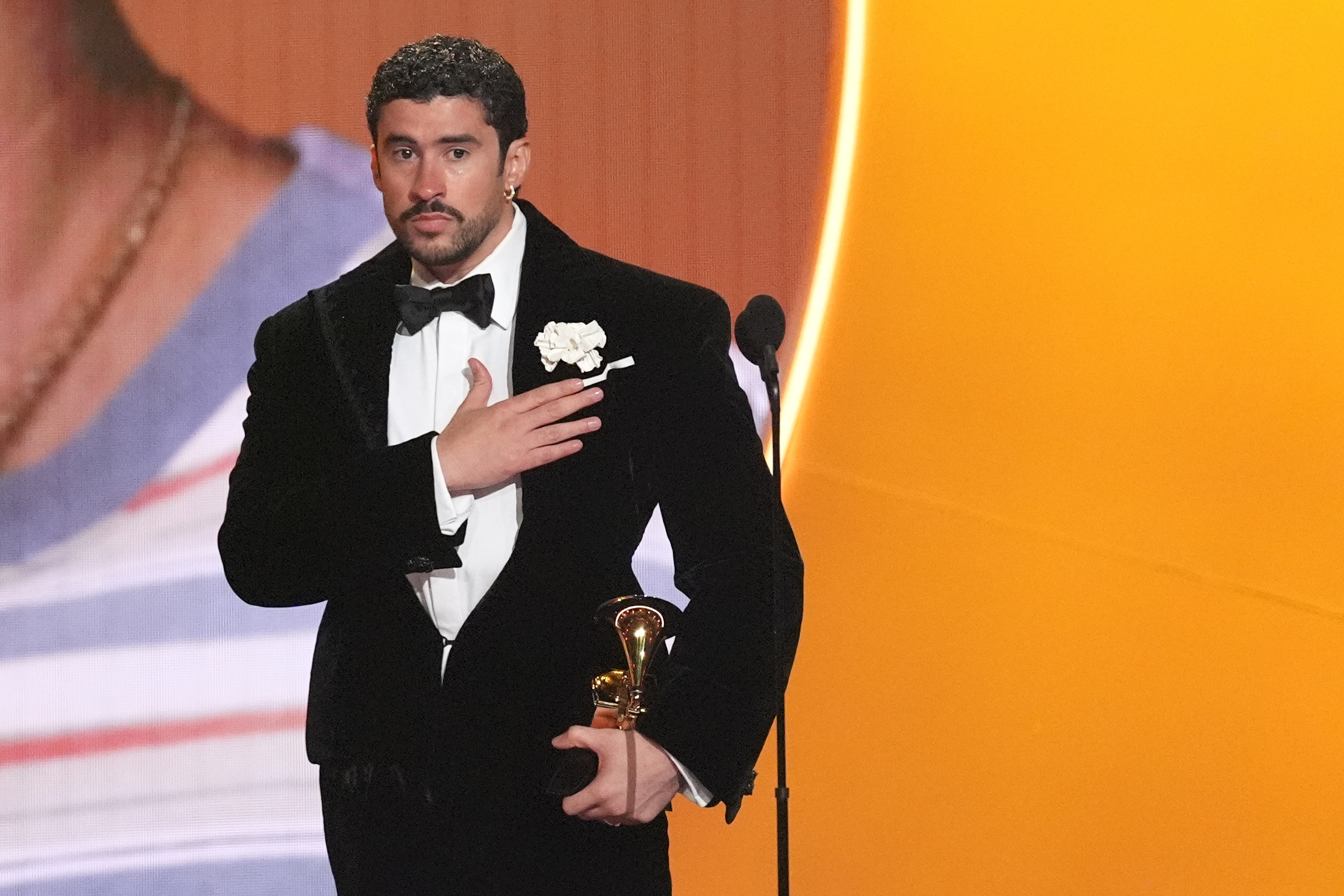
When Bad Bunny’s latest album received the Grammy Award for album of the year, the moment carried a weight that went far beyond music. It marked a turning point for representation, recognition, and cultural belonging in an industry that has historically kept Latino artistry at the margins.
The night the Recording Academy announced that Debí Tirar Más Fotos had taken the most prestigious prize of the evening, history quietly shifted. For the first time, an album recorded entirely in Spanish claimed the Grammy for album of the year, a category long associated with English-language releases and mainstream Anglo pop. The significance of that decision reverberated immediately, especially within Latino communities across the United States, where the boundaries between music, identity, and lived experience are often inseparable.
Bad Bunny’s recognition did not emerge in a vacuum; it unfolded during a year in which he collected several awards and prepared to lead one of the nation’s most widely viewed cultural showcases. Still, figures, accolades, and broad exposure alone cannot capture why this instance resonated so profoundly. The achievement became historic not only because of the album’s language, but also due to the deliberate refusal underpinning it: a refusal to translate himself, to temper his accent, or to water down the cultural elements that define his artistry.
A milestone that feels personal to millions
For many Latinos in the United States, Bad Bunny’s ascent has never felt distant or abstract. His success has unfolded in a way that mirrors their own negotiations with identity, belonging, and recognition. Raised in Puerto Rico and rooted firmly in Caribbean culture, he entered the global music scene without adopting the conventions traditionally expected of artists seeking crossover success.
Listeners such as Jeffrey Vargas, a Nuyorican from Brooklyn, portray the moment as profoundly validating, noting that the Grammy win served not only as a career milestone but also as a cultural affirmation, reinforcing the notion that narratives expressed in Spanish and shaped by migration, colonial legacies, and the experiences of urban Latino communities merit the same prominence as any other storyline in American music.
This feeling of closeness helps explain why the response spread well beyond traditional fan circles, as social networks rapidly filled with posts mixing joy with a sense of relief, and pride with steady determination. For countless listeners, the album had already become an emotional touchstone, providing solace and a sense of belonging during a time shaped by political strain and widespread uncertainty. The Grammy acknowledgment intensified that influence, turning what had been a private listening experience into a collective cultural event.
Authenticity emerges as an act of defiance rather than a deliberate tactic
One of the central hallmarks of Bad Bunny’s career has been his steadfast embrace of authenticity, and in a music industry that frequently pushes Latino performers to “cross over” by downplaying their cultural roots, he has moved in the opposite direction; instead of minimizing regional elements, he has amplified them, blending Caribbean rhythms, Puerto Rican slang, and local allusions throughout music crafted for listeners around the world.
This approach has strongly resonated with creators and cultural commentators nationwide, and Mexican-American content creator Liz Arreola portrayed his artistry as an evolution rather than a concession, comparing it to enriching flavor instead of watering it down, while her response reflected a wider belief that respect and global interest arise not through assimilation but through a clear, assured sense of identity.
The album that secured the Grammy reflects that philosophy, weaving its themes through memory, place, and community while giving listeners a candid portrayal of Puerto Rican identity. Rather than chasing a universal message through broad abstraction, it forges a bond by honing in on vivid, concrete details. In doing so, it pushes back against long-held industry beliefs about what mainstream success is expected to entail.
Redefining the meaning of mainstream recognition
For decades, Latino music in the United States has frequently been regarded as a niche, recognized through dedicated awards yet kept at the margins of the industry’s most prestigious accolades, with Spanish-language albums praised but seldom viewed as integral to the overarching story of American music.
Bad Bunny’s win disrupts that framework. It signals that Spanish-language music is not an exception to the mainstream, but an integral part of it. Political consultant and cultural advocate Luis Miranda emphasized this point by framing the victory as recognition of a reality that has long existed. Latino music, language, and culture have shaped the United States for generations, contributing to its artistic and social fabric in ways that cannot be confined to a single category.
This shift in recognition matters because awards do more than honor individual achievement. They shape industry priorities, influence investment, and send messages about whose stories are valued. By awarding album of the year to a Spanish-language release, the Recording Academy effectively acknowledged a broader definition of American music—one that reflects the country’s linguistic and cultural diversity.
A triumph molded by the society that surrounds it
Bad Bunny’s recognition arrived at a moment that carried additional resonance, as his Grammy victory unfolded while political discourse on immigration grew more heated, enforcement measures tightened, and disputes over national identity persisted. In such a climate, visibility gains further weight, and cultural accomplishments can serve as powerful symbols.
During his acceptance speech for best música urbana album, Bad Bunny addressed these realities directly. Speaking with clarity and restraint, he rejected dehumanizing narratives aimed at immigrants and Latinos, affirming their humanity and their place within American society. His message emphasized love as a counterforce to hatred, urging empathy over division.
The decision to use the Grammy stage in this way transformed the award ceremony into something more than entertainment. It became a platform for solidarity, particularly for communities living with fear and uncertainty. By centering immigrants, dreamers, and those who have left their homes in search of opportunity, his words echoed the lived experiences of millions.
Language as an expression of identity and inclusion
One of the most striking elements of Bad Bunny’s Grammy appearance was his decision to present much of his album of the year acceptance remarks in Spanish, a choice that carried notable symbolic force in an industry where English is often assumed to be the norm, underscoring that Spanish requires no translation to merit acknowledgment or esteem.
For immigrant communities watching from across the country, the moment resonated deeply. Media organizations serving Latino audiences described it as an act of solidarity, a public acknowledgment of shared struggles and hopes. The speech suggested that success does not require abandoning one’s language, even on the world’s most visible stages.
This focus on language ties directly into wider discussions surrounding cultural erasure and inclusion, and by using Spanish without hesitation, Bad Bunny pushed back against the belief that assimilation must precede acceptance, offering instead a model of achievement that treats linguistic diversity as an empowering asset rather than an obstacle.
Looking beyond accolades: dignity, humanity, and the essence of cultural remembrance
Although the Grammy trophies will remain embedded in Bad Bunny’s professional legacy, many observers contend that their true meaning extends beyond that. The honors reflect a moment when dignity and humanity moved to the forefront of a cultural institution that engages millions of viewers.
Community leaders like Lucria Ortiz have framed the victory as a reminder of the values embedded within Latino culture: joy, resilience, and a commitment to humanity. From this perspective, the album’s recognition represents not only artistic excellence, but a collective affirmation of cultural worth.
The impact reaches not only Puerto Rican communities but also Latinos from varied backgrounds who recognize traces of their own journeys within the music, and through motifs of migration, remembrance, or defiance, the album conveys collective histories that mainstream narratives frequently overlook.
A turning point, not an endpoint
It would be easy to frame Bad Bunny’s Grammy win as the culmination of a journey, but many view it instead as a starting point. The recognition opens doors for other artists who create in Spanish or draw deeply from regional traditions. It challenges institutions to reconsider how they define excellence and whose voices they elevate.
At the same time, the moment invites reflection on the responsibilities that come with visibility. Bad Bunny’s career suggests that global success and cultural accountability need not be mutually exclusive. By remaining connected to his roots while navigating international fame, he offers a model for artists seeking to balance authenticity with reach.
The wider message is unmistakable: visibility at the top tiers carries real weight, especially when it validates communities long pushed to the margins, and when Spanish-language music is treated not as an exception but as a cultural focal point, it shifts how people understand the full scope of American identity.
In the end, the importance of this Grammy moment rests not only in what will be recorded in history, but also in how it resonated with those who recognized themselves in it, and for millions of Latinos in the United States, Bad Bunny’s triumph represented far more than a musical achievement as it affirmed that their language, narratives, and identities deserve a central place in the cultural dialogue rather than being pushed to the margins.