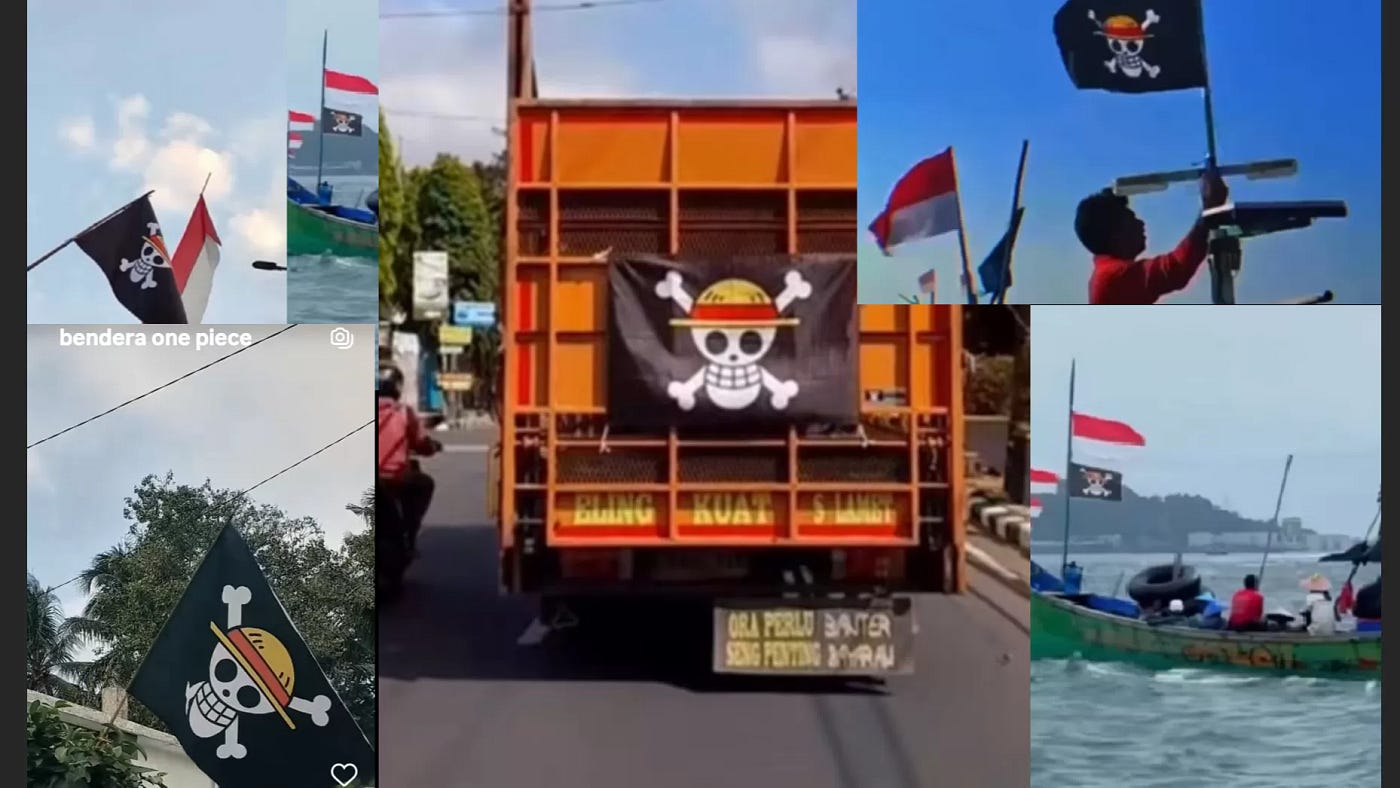
In recent years, a striking yet unassuming image has emerged as a potent emblem of defiance across Indonesia—a cartoonish skull, often rendered in bold lines and vibrant colors. What might appear at first glance as a piece of street art or underground graphic design has, in reality, transformed into a unifying symbol for activists, artists, and ordinary citizens pushing back against oppression, corruption, and social injustice. This symbol’s journey from obscurity to prominence is not just a story about art; it is a reflection of Indonesia’s complex political landscape, the power of grassroots movements, and the enduring human desire for freedom and expression.
The exact origins of the cartoon skull as a resistance symbol are difficult to pinpoint, as it emerged organically from Indonesia’s underground art and protest movements. Unlike state-sanctioned imagery or corporate logos, this symbol was never designed through official channels. Instead, it grew from the streets—spray-painted on walls, printed on homemade protest banners, and shared across social media by dissenting voices.
Some trace its roots to the punk and anarchist subcultures that have long thrived in Indonesia’s urban centers. Others link it to the DIY (do-it-yourself) ethos of independent artists who use bold, easily reproducible imagery to bypass censorship. The skull’s exaggerated features—often grinning, sometimes adorned with slogans or motifs—make it instantly recognizable, allowing it to spread quickly among activists who need symbols that can be replicated under oppressive conditions.
Skulls have long been used in art and symbolism to represent rebellion, mortality, and defiance. From the Jolly Roger of pirates to the calaveras of Mexican Day of the Dead traditions, skull imagery carries a universal weight. In Indonesia, the cartoon skull takes on additional layers of meaning.
For instance, its whimsical yet disquieting look serves as a powerful means for satire. With a caricature-like approach, creators and activists undermine the dread usually linked to skulls, transforming it into a symbol that ridicules power instead of submitting to it. The overstated smile might be interpreted as a sneer at dishonest leaders, exploitative companies, or harsh regulations.
Additionally, the simplicity of the skull is crucial to its effectiveness as a symbol of resistance. In contrast to intricate political manifestos or elaborate slogans, a thoughtfully created image can instantly express opposition. It transcends translation, overcomes literacy challenges, and allows for limitless adaptation—whether it’s spray-painted on a protest sign, featured on a T-shirt, or distributed as a digital sticker.
The rapid spread of the cartoon skull owes much to social media. In a country where mainstream media is often controlled or influenced by political elites, platforms like Twitter, Instagram, and Telegram have become vital spaces for dissent. Activists use these channels to share the symbol alongside hashtags related to labor strikes, environmental protests, and anti-corruption campaigns.
One of the reasons the skull prospers on the internet is due to its versatility. It is reimagined by digital artists, who incorporate additional elements to align with various causes, such as a gas mask for environmental demonstrations, broken chains for labor movements, or a scholar’s cap for student protests. Each version strengthens the emblem’s fundamental message while enabling diverse groups to adopt it as their emblem.
Authorities have attempted to restrict its distribution, marking posts featuring the skull or even detaining people for showing it. However, these strict measures frequently have unintended consequences, as forceful actions only enhance the symbol’s appeal as a sign of defiance. The harder the government tries to eliminate it, the more it turns into a symbol of pride for those who oppose.
Indonesia has a complex relationship with opposition. Although the nation moved towards democracy following the collapse of Suharto’s authoritarian rule in 1998, the right to free speech continues to be challenged. Legislation against defamation, blasphemy, and “inciting hatred” is frequently utilized to silence opponents, and symbols of protest are often outlawed.
The animated skull has undergone similar analysis. Officials have described it as “rebellious,” “radical,” or even connected it to extremist organizations in an attempt to undermine its supporters. Law enforcement has apprehended demonstrators for displaying flags with the skull, and government-associated media sometimes broadcasts programs cautioning about its “perilous impact.”
However, instead of disappearing, the emblem has only become more powerful. Every effort to eliminate it highlights its significance as a sign of defiance. When authorities view a sketch as a danger, they unintentionally acknowledge the strength of art as an instrument of dissent.
The cartoon skull is not unique in its function—it joins a long history of symbols adopted by resistance movements worldwide. The raised fist, used by Black Power activists and labor movements, conveys solidarity and strength. The Guy Fawkes mask, popularized by V for Vendetta and Anonymous, represents anonymity and rebellion against tyranny. Even something as simple as a safety pin has been worn as a sign of solidarity with marginalized groups.
What sets Indonesia’s skull apart is its profound link to local challenges. This symbol is not imported; it developed naturally from the nation’s own history of opposition. It resonates as it mirrors Indonesian humor, resilience, and ingenuity when faced with hardship.
Mientras la desigualdad, la corrupción y la represión continúen en Indonesia, es probable que la calavera caricaturesca siga siendo un elemento constante en la cultura de protesta. Su significado puede cambiar: lo que ahora representa los derechos laborales podría simbolizar la justicia climática en el futuro, pero su función principal como herramienta de resistencia perdura.
Perhaps the most remarkable aspect of this symbol is its democratization. No single person or group owns it; it belongs to whoever picks up a spray can, shares an image online, or wears it on their sleeve. In a world where dissent is increasingly surveilled and controlled, the fact that a simple drawing can still unsettle those in power is a testament to the enduring strength of collective resistance.
The cartoon skull’s rise from underground art to national symbol of defiance is a reminder that resistance does not always come in the form of grand speeches or armed uprisings. Sometimes, it is a grinning face on a wall, a shared image on a phone, or a sticker slapped onto a street sign.
In Indonesia, where freedom of expression is often under threat, the persistence of this symbol proves that ideas cannot be easily erased. The skull is more than just an image—it is a statement, a challenge, and a promise that the fight for justice will continue, one bold stroke at a time.