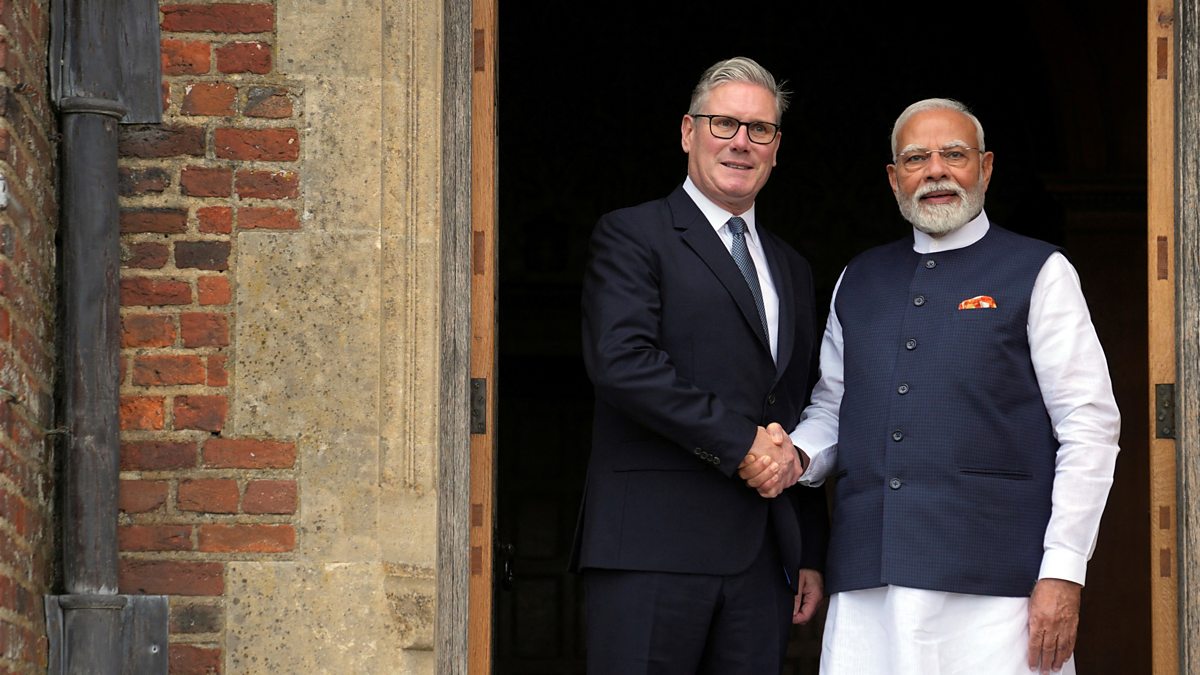
The United Kingdom and India have embarked on a new phase of economic partnership as Prime Minister Keir Starmer and Indian Prime Minister Narendra Modi sealed a historic trade deal worth £6 billion. This agreement represents a crucial step in strengthening the economic and diplomatic ties between the countries, paving the way for fresh opportunities in areas like technology, pharmaceuticals, sustainable energy, and financial services.
This latest agreement comes after years of negotiations aimed at strengthening bilateral ties in the post-Brexit era. With the UK seeking to redefine its global trading position and India continuing its rise as a major economic power, both governments see this deal as a mutually beneficial step forward. The partnership not only aims to increase the flow of goods and services but also sets a precedent for broader collaboration on innovation, infrastructure, and investment.
For Prime Minister Starmer, the agreement represents one of the first major foreign policy achievements of his leadership. His government has prioritized renewing global partnerships with emerging economies, and this deal with India aligns with that strategic vision. By securing an agreement of this scale early in his tenure, Starmer signals a commitment to restoring the UK’s global economic relevance.
The agreement involves mutual pledges by both countries to reduce trade obstacles, encourage investment, and enhance job opportunities. Various companies from the UK are anticipated to extend their businesses in India, whereas Indian corporations will broaden their activities in the UK markets. This mutual strategy is projected to enhance job creation and economic participation in both regions.
One of the main components of the agreement is improved partnership in the technology field. With India’s growing digital economy and the UK’s well-established tech sector, both nations are poised to gain from greater collaboration in areas such as artificial intelligence, cybersecurity, and software development. Joint expertise and international innovation are at the heart of this part of the deal.
Healthcare and pharmaceuticals also feature prominently in the trade package. Indian pharmaceutical companies, known for their global production capacities, will gain more streamlined access to UK markets. In return, British health technology firms are poised to enter India’s growing healthcare infrastructure space, bringing advanced medical technologies and digital health solutions.
Green energy is another focal point. Both nations have committed to environmental goals under international climate agreements, and this deal reinforces a shared agenda to advance sustainable practices. The agreement outlines joint efforts in clean energy research, electric mobility, and renewable infrastructure. These initiatives are expected to support long-term emissions reductions while creating new business ventures and employment opportunities.
Financial services, a historically strong sector in the UK, will also see expanded collaboration. Indian banks and financial institutions are expected to deepen their engagement with the London financial ecosystem, while British firms explore India’s rapidly growing financial markets. This cross-investment is anticipated to strengthen regulatory cooperation and facilitate capital flow between the two economies.
Education and workforce development are also embedded in the framework. As part of the agreement, both countries have agreed to promote academic exchanges and skills training initiatives. This includes simplifying visa processes for students and professionals, encouraging collaboration between universities, and supporting mutual recognition of qualifications.
For India, the deal presents an opportunity to access cutting-edge British technologies, attract investment into key industries, and increase exports to a major Western market. For the UK, India offers access to a vast and rapidly growing consumer base, as well as a hub for innovation and skilled labor. The strategic alignment reflects a broader geopolitical shift, as countries seek to diversify trade partners amid changing global dynamics.
Critics and trade analysts, however, will be closely monitoring the implementation of the deal to ensure that commitments translate into tangible outcomes. Questions remain about regulatory alignment, labor standards, and how the agreement will impact small businesses in both countries. Transparency and accountability in the deal’s rollout will be key to its long-term success.
In a larger context, this accord addresses evolving global economic trends. As systems for multilateral trade encounter growing obstacles, bilateral accords of this nature are increasingly prevalent. The UK-India collaboration might act as a template for future agreements with other rapidly growing economies.
Diplomatically, the agreement also symbolizes a deepening political relationship. Beyond trade, both governments have pledged to collaborate on strategic issues such as regional security, defense cooperation, and counterterrorism. These shared commitments enhance the geopolitical dimension of the economic partnership, reinforcing both countries’ interests in a stable and multipolar international order.
With the signing of this £6 billion trade deal, the UK and India enter a new chapter of collaboration. The agreement reflects a shared ambition to build a resilient, forward-looking partnership capable of adapting to future challenges. As details of the agreement begin to take effect, all eyes will be on how this economic bridge between London and New Delhi transforms trade, innovation, and diplomacy in the years to come.